How to run an esports tournament final
An esports final is three events at once: a competition that must be fair, a show for the people in the arena and a broadcast for everyone else. This guide walks through how those three layers fit together, in the order a producer plans them.
Updated 23 November 2026 · by the Zsight production team
1. Start with the competition, not the stage
Fix the competitive format first: number of teams, stages, match format, schedule per day and who decides the rules. For a publisher-led league such as PUBG Mobile Super League or the VALORANT Champions Tour, the publisher sets the ruleset, the match schedule and the technical standards. For a brand-led tournament, the organiser sets them and the producer turns them into a floor plan and a run of show.
Everything else depends on this. A 16-team, three-day final needs different backstage space, rest areas, practice rooms and broadcast slots from a two-day, single-bracket show. At PUBG Mobile Super League Europe 2025 Fall, 16 teams played over three days at Complex Istanbul with six places at the Global Championship at stake; the schedule drove the broadcast plan, not the other way round.
2. Choose the venue for operations first, atmosphere second
A good esports venue is one where players can compete, crews can load in and a broadcast can run, and only then one that looks good on camera. Check these points before signing a venue:
- Load-in: vehicle access, dock height, lifts and the time window for rigging.
- Power and data: capacity per area, redundant feeds and a dedicated network for the competition.
- Rigging and ceiling height for lighting, LED and camera positions.
- Sightlines for the audience and camera lines to the stage.
- Player and team areas: warm-up rooms, quiet space and separate access so teams do not cross audience routes.
- A broadcast compound close to the stage and the player area, with its own power and cable routes.
- Capacity, safe exits and permits for the planned audience.
3. Plan competition operations
Competition operations are the part the audience never sees and the part that decides whether the event is trusted. Assign a tournament admin team, referees, technical support for player stations and a clear process for protests and technical pauses.
For mobile titles, plan the devices and the network as carefully as the stage: matched devices or accounts, controlled Wi-Fi or wired setups as the publisher requires, and a process for charging and swapping equipment between matches. For PC titles, plan identical machines, peripherals and a staging area where teams can check settings before going on stage.
4. Design the stage as a broadcast set and an arena
The stage has two jobs: be readable for the room and for the camera. Play desks, screens, lighting and branding are designed for both. Keep sponsor placements in the camera frame, leave enough space for camera movement, and agree the look of on-screen graphics with the stage design so they match.
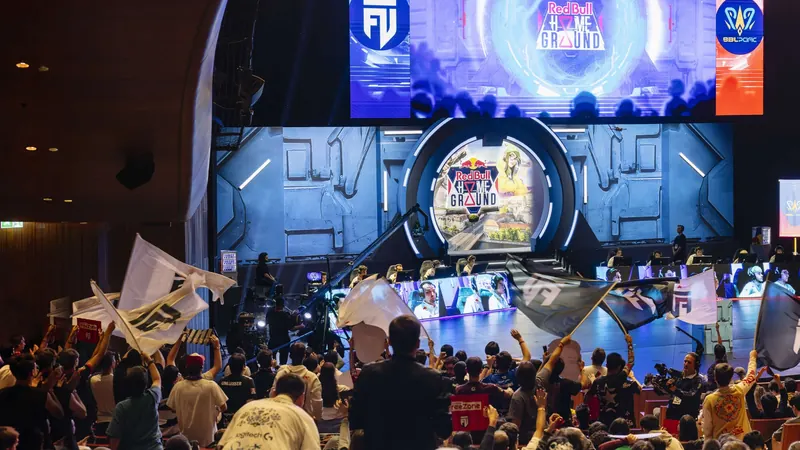
Interactive zones, activations and creator areas bring the audience into the event outside match time. For the two-day Red Bull Home Ground final at the Atatürk Cultural Center in Istanbul, with 2,000+ attendees, Zsight designed the stage and fan experience, built the interactive zones and managed the event on site.
5. Treat the broadcast as a separate production
The broadcast needs its own producer, crew, signal chain and run of show, tied to the competition schedule. Decide early whether the broadcast uses the publisher's world feed, a local production, or both, and which languages are produced. See our guide to esports broadcast production for the full breakdown.
6. Build the run of show and the timeline backwards
Work backwards from show day. As a rule of thumb, venue and format decisions come first, then supplier and stage design, then broadcast and competition operations, then marketing and ticketing. Large finals with an international field need more lead time than a single-country event, because travel, visas and publisher approvals add dependencies.
The run of show lists every minute of every day: doors, warm-ups, matches, breaks, ceremonies, sponsor moments and broadcast cues. Rehearse it on site with the crew before the first match.
7. Know your budget lines
Budgets for esports finals usually break into the same groups. Planning them as separate lines makes quotes comparable:
- Venue hire and venue services.
- Stage, lighting, LED and sound.
- Competition operations, player areas and equipment.
- Broadcast production, talent and distribution.
- Audience experience, activations and hospitality.
- Staffing, security, medical and insurance.
- Travel, accommodation and logistics for teams and crew.
- Contingency.
8. Plan for what goes wrong
Write down the five most likely failures and the response for each: a player machine fails, the network drops, a team is late, a camera or audio feed fails, the venue loses power in one area. Assign owners, keep spare equipment on site and brief the broadcast and operations teams on the same escalation path.
Weather, transport delays and visa issues matter for international events. Build buffer days for arrivals and give teams a single point of contact.
A sample show day, hour by hour
Every final has its own rhythm, but most show days follow the same shape. Use this as a starting skeleton and adjust it to the competition schedule.
- Early morning: crew call, safety briefing and final checks of stage, power and network.
- Before doors: technical check of player stations, broadcast rehearsal and a last walk-through with the competition admins.
- Doors open: audience entry, activations open, pre-show on the arena screens.
- Match blocks: competition play with scheduled breaks for the broadcast, the arena show and any technical pause.
- Ceremonies: trophy presentation, interviews and sponsor moments planned with the broadcast and the stage team.
- After the final: audience exit, de-rig plan and a debrief with all teams while details are fresh.
Roles on site
- Executive producer or event director: owns the plan and decisions.
- Competition lead and admins: rules, schedule, referees and player areas.
- Technical director: stage, power, network and equipment.
- Broadcast producer and director: the stream and the arena screens.
- Stage manager: cues for stage, lighting and talent.
- Venue and safety lead: access, security, medical and crowd flow.
- Partner and sponsor lead: activations and hospitality.
- Content lead: photo, video and social content during the event.
Audience, tickets and partners
Decide early whether the event is ticketed, invitation-only or open, because it affects venue capacity, registration, entrance flow and marketing. Plan the audience experience beyond the matches: fan zones, creator meet-ups, merchandise and food. Sponsors need visibility on stage, on the broadcast and in activation areas, and every placement should be agreed with the publisher if one is involved.
Content and reporting after the final
Capture photos, video and social clips during the event and plan their publication in advance. Report to partners with the facts that matter to them: attendance, peak concurrent viewers, social reach and content delivered. Zsight's project pages follow this logic, with figures such as 3,000 people in the arena and 200,000+ peak viewers at BBL Esports' VCT EMEA watch party at Volkswagen Arena Istanbul.
Common mistakes
- Choosing the venue before fixing the competitive format.
- Treating the broadcast as an add-on instead of a parallel production.
- No separate network for the competition.
- Under-planning player areas and rest space.
- No written escalation path for technical problems.
- Late decisions on sponsor placements that change the stage design.
Related services
Esports and gaming events
Esports tournament finals, gaming festivals and watch parties: stage design, event management and broadcast from Istanbul.
Live broadcast and streaming
Multi-camera live broadcast, hybrid events and streaming production from Istanbul, for corporate events and tournaments.
Related projects
Questions
How long does it take to organise an esports final?
It depends on the size of the field and on the publisher's requirements. As a rule of thumb, plan venue and format decisions months ahead and leave more time for international events, because travel, approvals and supplier lead times add up.
Who is responsible for the broadcast at an esports final?
For publisher-led leagues the publisher defines the broadcast standards and often supplies the game feed, and a local production company can produce the on-site show and local-language broadcast. For brand-led tournaments the organiser or its production partner owns the whole broadcast.
Can an esports final be held in Istanbul?
Yes. Istanbul has hosted international esports finals, including VALORANT Champions 2022 and the European finals of PUBG Mobile Super League in 2025, and Türkiye is scheduled to host the M8 World Championship in January 2027.
Planning something similar?
A producer replies within one working day with first ideas, questions and a budget range.
Start a project